
Beyond Feasibility: How Changeable Redefined Market Validation with Behavioural AI


The Challenge
One of our clients had an idea to launch a national, consumer‑to‑consumer swap marketplace with no cash involved. Instead of relying on conventional feasibility methods, we sought real‑world insight into how people would behave — validating, iterating, and ultimately determining a defensible go / no‑go decision.
Out Thought Process
We treated the concept as a set of behavioural hypotheses rather than a product build. Success would depend on whether real users could overcome trade‑offs of time, trust, effort, and fairness.
We examined the idea through multiple lenses:
- People: Persona‑based behavioural drivers, friction points, and motivations.
- Exchanges: How bilateral trade without money changes fairness perception.
- Trust: Assurance, reputation, and perceived risk.
- Context: Micro and macro forces shaping feasibility.
Methodology Overview
1. Persona Generation and Calibration
We created a synthetic population of AI agents modelled on empirical NZ demographic and psychographic data
Each persona carried calibrated behavioural parameters:
- Risk tolerance: willingness to transact without prior trust
- Value sensitivity: fairness threshold
- Effort vs reward bias: friction tolerance
- Privacy preference: comfort with ID verification or exposure
These personas provided the human foundation for realistic market simulations.
2. Market Simulation Engine
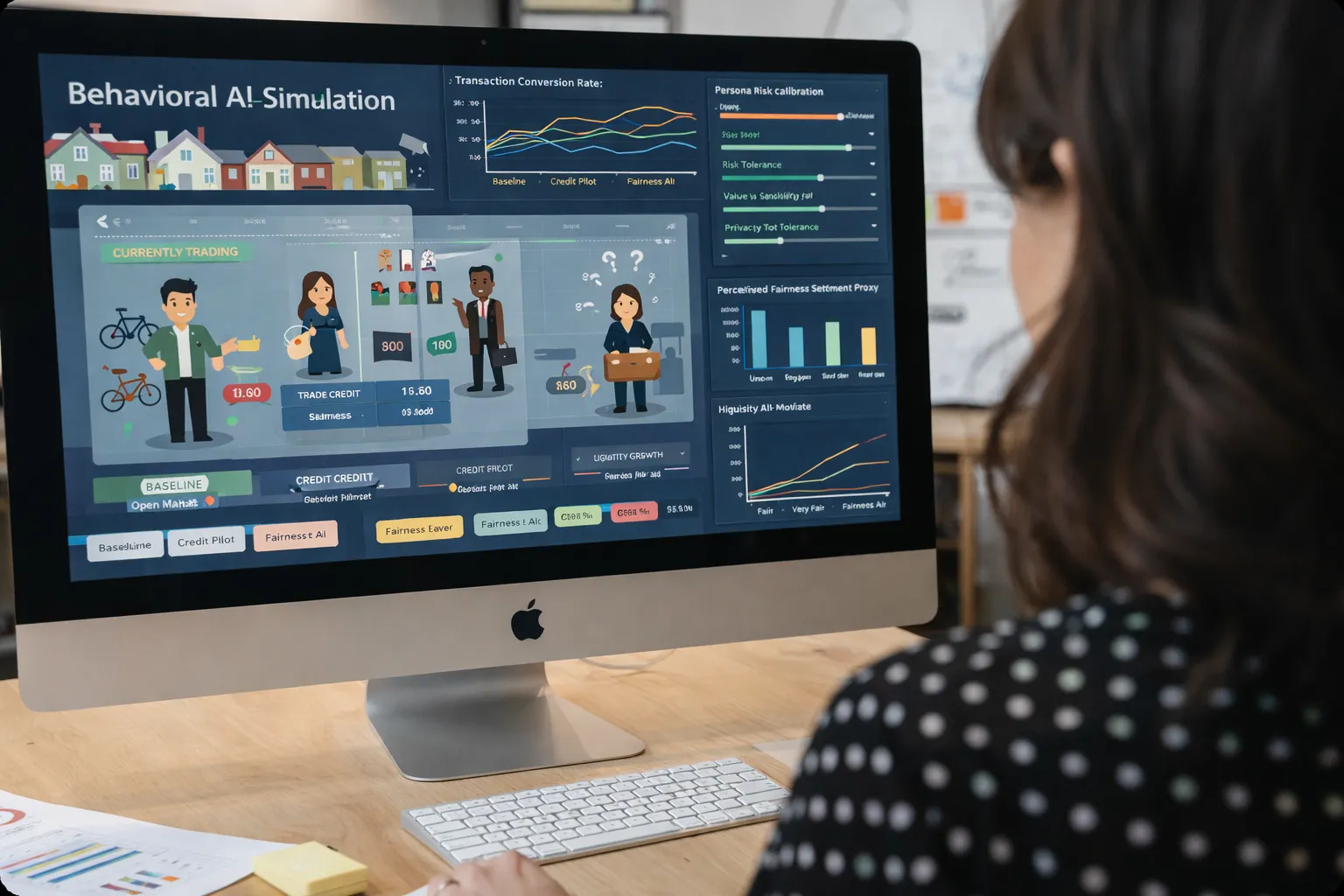
We built a dynamic virtual economy where agents listed, browsed, negotiated, and completed swaps. The simulation included:
- Macro inputs: economic confidence, household savings, cost‑of‑living pressures.
- Micro variables: inventory density, time costs, location clustering.
- Reinforcement learning model: agents acted on satisfaction vs effort logic: if satisfaction > effort → repeat; else → exit.
- Perturbations: simuated policy changes, incentives, and market bursts to test elasticity.
3. Scenario Development
We tested several policy and design conditions:
- Baseline: open swap market, no credits or assurance.
- Governed Swap: trade‑credit system (consumer‑grade Bartercard equivalent).
- AI‑Mediated Fairness: algorithmic suggestions for “balanced” trades or small credit top‑ups.
- Assurance Layer: vouching, trust tokens, or community endorsements.
- Regional Density: comparison between hyper‑local and dispersed networks.
4. Metrics Captured
We collected performance and sentiment data across all scenarios:
- Transaction conversion rates
- Trust breaches and user drop‑offs
- Average negotiation cycles
- Perceived fairness (sentiment proxy)
- Liquidity growth curves
5. Learning Extraction
AI analytics clustered successful transactions to identify which behavioural levers: trust, fairness, effort, and emotional resonance most influenced repeat participation. We also mapped failure modes, analysing where deals collapsed and why.
Outcomes and Deliverables
- Behavioural Models — data‑backed frameworks describing how consumers behave in non‑monetary exchanges under varied trust and parity regimes.
- Policy Playbooks — evidence‑based guidance for councils, sustainability groups, and marketplaces to foster safe micro‑economies.
- AI Trust Scaffolds — reusable architectures that simulate and stabilise low‑trust environments; transferable to Changeable’s governance consultancy.
- Zero to AI Content — narrative assets (“We built an AI society to test human trust”) that translate technical work into relatable learning content.
Strategic Significance
By using AI to replicate human market behaviour, Changeable built a unique capability:
- Test human-AI interaction dynamics in controlled, data‑rich conditions.
- Generate proprietary behavioural IP.
- Bridge AI systems design with behavioural economics and governance insight.
This positions Changeable as a leader in applied AI ethics, human‑centred design, and governance strategy — not just as a builder of tools, but as a builder of understanding.
Macro & Micro Context
To ensure validity, we grounded the behavioural analysis in real‑world trends:
Consumer Behaviour Trends
- Sustainability vs convenience paradox: People value circularity, but default to ease.
- Trust inflation: Increased scepticism demands stronger assurance design.
- Localism resurgence: Neighbourhood‑scale trust beats national anonymity.
- Digital fatigue: Simplicity now equals credibility.
Economic & Market Forces
- Cost‑of‑living crisis: Makes swapping attractive, yet amplifies risk aversion.
- Mature resale ecosystems: Raise expectations for UX and protection.
- Time scarcity: Friction directly reduces engagement.
- Privacy sensitivity: Transparency and consent are non‑negotiable.
Analytical Framework & Validity
We enhanced reliability through multiple validation layers:
- Triangulation: combined qualitative interviews, secondary data, and simulation.
- Sensitivity analysis: tested parameter stability (effort, value gap, distance).
- Bias checks: ensured persona weighting mirrored NZ diversity.
- Benchmarking: compared outcomes with barter groups, local markets, and resale platforms.
- Cross‑validation: stress‑tested findings against macroeconomic indicators.
Outcomes & Benefits
- Decision clarity: Behavioural friction outweighed novelty appeal — no‑go for national rollout.
- Evidence‑based pivot: Suggested a localised pilot to test trust and fairness mechanics.
- Reusable IP: Persona models, fairness bands, and liquidity analytics now feed Changeable’s future Behaviour Lab framework.
- Strategic savings: Prevented premature capital spend; delivered insight that scales to governance and sustainability sectors.
What This Set in Motion
This project formed the conceptual foundation for the Ministry of Insights Behaviour‑Led Validation Framework, integrating behavioural science with AI‑based simulation. It provides a blueprint for:
- Predictive trust modelling.
- Market ethics analysis.
- Real‑world simulation of human‑AI systems.
It demonstrates how Changeable merges empirical design, ethical governance, and applied AI to turn uncertainty into understanding.
Ready to test your ideas against human behaviour before you build?
Let’s design an anonymised, behaviour‑first validation for your concept.
Have a question about Behavioural AI?
Why didn’t Changeable use traditional feasibility or market research methods?
Traditional methods excel at measuring interest and intent, but they struggle to reveal how people actually behave when trust, fairness, and effort are involved. We used behavioural AI because swapping without money is driven by human psychology, not just preference surveys.
What made this challenge uniquely suited to behavioural simulation?
A swap-based market removes price signals and replaces them with subjective fairness and trust. That means success depends on behavioural thresholds rather than supply-demand modelling alone. Simulation helped us observe what users would do, not just what they say.
How realistic were the personas and simulations?
Personas were calibrated using New Zealand demographic and psychographic data, with behavioural traits like risk tolerance and effort bias. Simulations incorporated macroeconomic factors, location density, and reinforcement learning so agent behaviour approximated real-world trade dynamics.
What kinds of scenarios were tested?
We modelled multiple swap configurations, including open markets, credit-based barter, fairness-assisted trades, assurance features, and local versus national density. This allowed us to compare adoption and drop-off under different trust and friction conditions.
How did you measure success or failure?
We tracked transaction conversion rates, negotiation cycles, drop-offs, perceived fairness, trust breaches, and market liquidity curves. These metrics provided evidence for whether participation would grow or collapse over time.
Did the simulations show the marketplace could work nationally?
No. Behavioural friction consistently outweighed novelty appeal in a national model. Trust, time effort, and fairness concerns prevented sustainable adoption at scale. A localised pilot proved more viable as an incremental strategy.
Why is a “no-go” outcome still valuable?
It prevents large capital spend on an unvalidated assumption. It also redirects investment toward models that do work, such as hyper-local trust networks, community marketplaces, or credit-supported swap systems. Insight beats optimism.
What did the client receive at the end of the engagement?
They received behavioural models, scenario analytics, trust scaffolding patterns, and strategic guidance. Alongside this were policy playbooks and communication assets that translate complex findings into clear decisions for stakeholders.
Can this approach be applied to other markets or products?
Yes. Any product where trust, fairness, risk, or effort play a central role — marketplaces, sustainability schemes, public sector mechanisms, shared resources — can benefit from behavioural simulation before building.
How does this differentiate Changeable from other AI consultancies?
We don’t just build tools. We model human behaviour, ethics, and system dynamics to answer the hardest question early: Will this work once real people use it? Our approach combines AI, behavioural science, and governance to inform strategic decisions, not speculative builds.
When should an organisation consider behavioural validation?
When uncertainty is high, trust is pivotal, friction threatens engagement, or market novelty risks overconfidence. Behavioural AI provides clarity before investment and avoids costly optimism bias.
What did this project set in motion for Changeable?
It seeded the Ministry of Insights Behaviour-Led Validation Framework — our structured method for pressure-testing ideas against behavioural realities. The reusable IP now supports governance, sustainability, and marketplace strategy engagements.
