AI-powered document intelligence
By embedding AI into document workflows, agencies can reduce delays, improve compliance, and deliver better service to citizens.
AI Document Processing
Regional Council
August 2025
New Zealand

Success lies in designing the future state with staff, not for them.
When change is co-created and governance is at the centre, AI becomes a powerful enabler of fairer, faster, more accountable public services
Challenge:
Public sector organisations — councils, government agencies, and police — are drowning in documents. Permits, applications, procurement contracts, compliance records, reporting obligations… the list is endless.
In my experience working with NZ Police and across local government, I’ve seen first-hand how manual document-heavy processes become bottlenecks. For example:
- Procurement approvals would stall because documents had to be manually reviewed and signed off by multiple stakeholders.
- Resource consents or permit applications could sit in queues for weeks, frustrating communities and businesses.
- Compliance and audit preparation often required staff to chase documents across multiple departments.
The result? Staff burnout, public dissatisfaction, and a growing sense that government “can’t keep up.” These inefficiencies weren’t due to lack of effort — they were systemic, caused by paper-heavy, siloed processes.
The common thread? Processes grew organically over time, but were never designed for efficiency. Stakeholders often created “Roblox-style workarounds” just to keep operations moving. The result was:
- Staff bogged down in repetitive admin
- Poor visibility of stock and financials
- Inefficient onboarding and workload management
- Inconsistent customer experiences
These inefficiencies compounded as businesses grew, creating stress, wasted resources, and lost opportunities.
Solution:
The key is introducing AI-powered document intelligence into workflows. Rather than replacing staff, AI becomes the “first reviewer,” handling the repetitive grunt work while humans retain oversight.
In my projects, the approach always began with engagement and mapping:
- Sitting with staff across functions to understand how documents were handled end-to-end.
- Identifying bottlenecks and rework loops (e.g., approvals bouncing between teams).
- Designing a “future state” where technology supported — rather than disrupted — existing structures.
AI can then be deployed to:
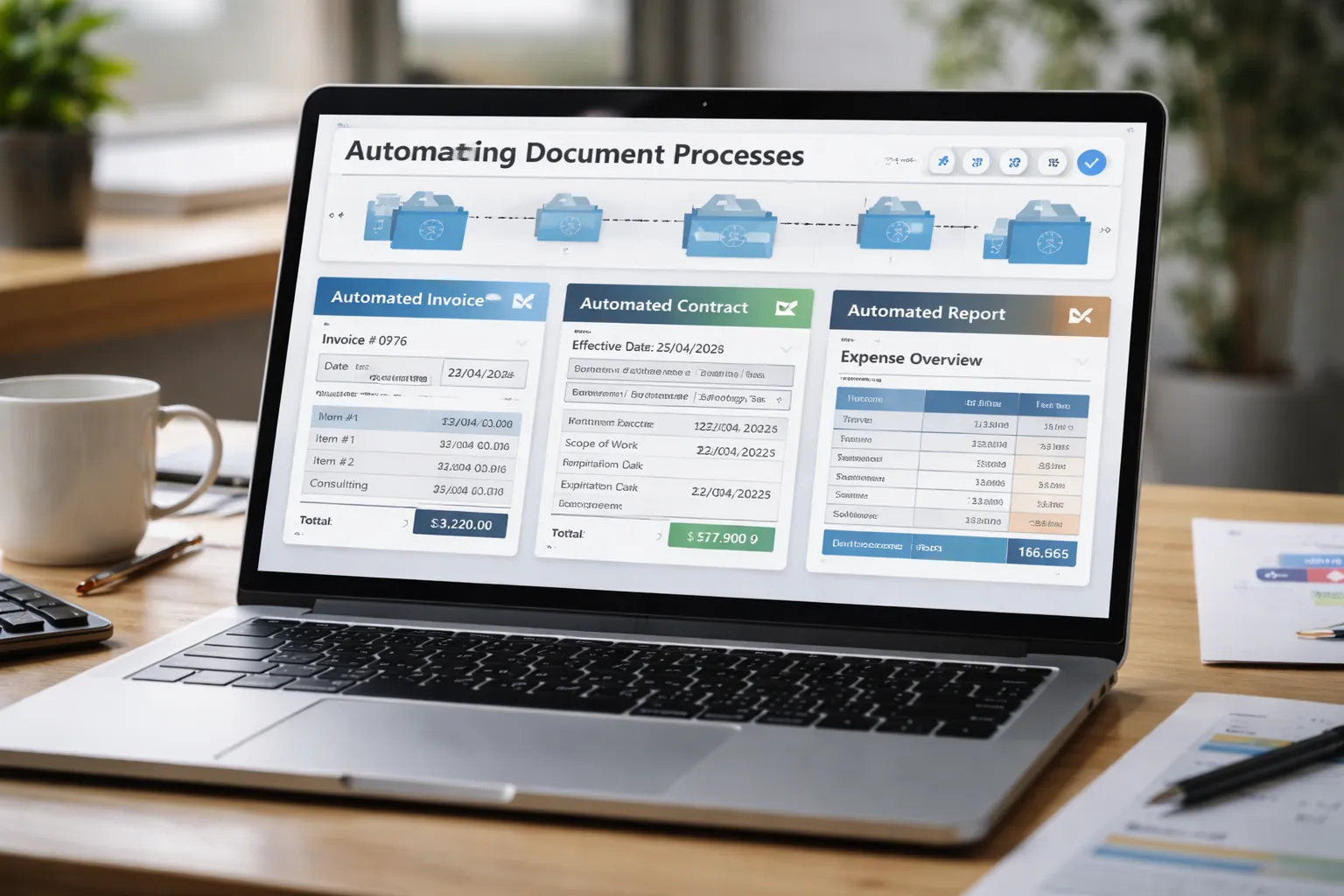
- Automatically scan and categorise incoming documents.
- Extract key data points (like dates, names, contract values).
- Flag compliance risks for staff to review.
- Route approvals to the right person instantly.
- Create a transparent, audit-ready digital trail.
Crucially, this works only when paired with strong governance and ethics frameworks — ensuring decisions remain accountable and communities can trust the process.
Impacts and Benefits
Governments and councils adopting AI in document processing report significant gains, many of which align with what I’ve witnessed:
- 50–70% faster turnaround for permits and approvals.
- Reduced errors and omissions thanks to automated extraction.
- Staff redeployed from paperwork to higher-value, citizen-facing work.
- Clearer compliance trails, easing the stress of audits.
- Improved community satisfaction from quicker, more transparent service.
I’ve also seen the cultural shift that happens when staff realise AI is there to support, not replace them. Teams that once feared automation began to appreciate the relief from repetitive tasks, and instead leaned into work requiring judgement, empathy, and policy insight
Have a question about AI Powered Document Intelligence?
What is “AI-powered document intelligence”?
It refers to using AI to read, classify, and extract information from documents so staff do not have to manually process every page. AI becomes the first reviewer, passing only exceptions or risks to human experts for final decision-making.
Does this replace staff or automate them out of work?
No. In councils and government agencies, AI is best used to remove repetitive administrative tasks, not replace people. Staff still retain authority and judgement, especially where fairness, compliance, and public accountability are involved.
What kinds of documents can be automated?
Typical examples include:
permit and consent applications
procurement and contract documents
resource management forms
compliance and audit records
internal reporting and financial documentation
If a document follows a consistent structure or contains predictable fields, AI can likely support it.
How does AI improve turnaround times?
Manual processing often requires staff to:
open, read, compare, and route documents
validate details
check compliance or policy alignment
AI can automate initial classification, data extraction, routing, and checking. This means staff review exceptions rather than every case, significantly reducing queue times.
Is this secure and compliant with government requirements?
Yes. Responsible deployment includes:
privacy and information management alignment
auditability and traceability
human-in-the-loop oversight
risk and bias controls
Changeable’s approach embeds governance from the outset to ensure systems are trusted, transparent, and ethically sound.
How do you ensure staff buy-in?
We design processes with staff, not around them. That means:
mapping current workflows collaboratively
co-creating the future state
safeguarding roles and responsibilities
involving frontline workers in testing and refinement
This builds confidence and reduces fear of automation.
Can AI handle exceptions or ambiguous cases?
It can flag them, but humans make the decision.
AI handles high-volume, low-risk cases so staff have more time for:
complex judgement
community engagement
policy interpretation
stakeholder management
What are the measurable benefits?
Across public sector use cases, agencies typically report:
50–70% faster processing
fewer manual errors
reduced rework and approval bottlenecks
improved audit readiness
better citizen satisfaction
reduced staff burnout
Will this require replacing existing systems?
Not always. AI can integrate with existing tools and workflow systems rather than replacing them. In many cases, it’s a layer of intelligence added to current processes instead of a full technology overhaul.
How long does implementation take?
Timelines depend on document complexity, governance requirements, and change readiness. Many agencies begin with targeted pilots to demonstrate value before scaling.
Why is governance and ethics emphasised so strongly?
Because public trust is essential. Automating document workflows touches privacy, fairness, and accountability. Governance ensures AI aids decision-making without removing transparency or human oversight.
What makes Changeable’s approach different?
We focus on:
human-centred design
co-creation with staff
public sector governance
practical implementation rather than hype
The goal is not just faster processing — it is fairer, more transparent service delivery citizens can trust.